This article draws on Creative Navy's project work in embedded interface design. We work within the standards frameworks that govern these environments, including ISA-101 for HMI design, ISO 13849 and IEC 62061 for machinery safety, and IEC 61508 functional safety requirements, treating these as structural inputs to the design process rather than compliance checklists.
A 100-employee retailer carries approximately $620,000 in annual staff turnover costs, and POS interface friction is a named contributor to the cashier dissatisfaction that drives that figure (Appriss Retail, November 2025). The question for a product director is not whether a poor cashier-facing interface has an operational price. It does. The question is which platforms are actually closing the gap between what their release notes promise and what a cashier handling 84 transactions per hour needs.
This review assesses five major POS platforms against four operational criteria drawn from field research with cashiers in live retail environments. It is written for product directors and senior PMs who need to understand the state of the competitive landscape: not to evaluate usability in the abstract, but to identify where sense decay is already visible across the market and where an organisation willing to treat the cashier interface as infrastructure has a genuine competitive vector.
The platforms assessed are Square, Toast, Lightspeed, NCR Aloha/Voyix, and Oracle MICROS Simphony. The assessment draws on vendor documentation, independent usability reviews, and verified practitioner accounts from 2023 to 2026.
Key Figures
- $29 billion: estimated global POS software market value, 2023
- 27 to 28%: Square's approximate share of POS installations, as of 2024
- ~24%: Toast's approximate share of POS installations, as of 2024
- 75.8%: annual turnover rate for hourly retail roles (BLS-based analysis, as of May 2024)
- $620,000: estimated annual turnover cost for a 100-employee retail store, with POS interface friction named as a contributing factor (Appriss Retail, November 2025)
- 2 to 3 seconds: documented product search delay in Square Register following the September 2025 forced UI rollout, per multiple user reports in Square Community forums
- 64%: share of shoppers attributing deteriorating retail experiences to poorly trained or unprepared staff (2023 Retail Customer Experience Survey)
The Operational Coherence Test
Most POS evaluations assess feature coverage: payment types, inventory modules, reporting depth. This review uses a different frame. The Operational Coherence Test assesses whether a platform holds operational logic under real cashier conditions, across four criteria.
| Criterion | What it measures |
|---|---|
| Attention economy | Can the interface be used without sustained visual focus? |
| Conditioning stability | Does the interface survive a forced update without disrupting established motor sequences? |
| Taxonomy alignment | Does item search match how cashiers name products, not how the product database was structured? |
| Error recovery speed | When a transaction fails, how many steps and how much time does recovery add? |
The Operational Coherence Test assesses POS interfaces against four criteria: attention economy, conditioning stability, taxonomy alignment, and error recovery speed. These are the dimensions on which the gap between a laboratory-tested interface and a cashier handling 84 transactions per hour is most reliably visible. A platform that resolves all four will outperform a more feature-rich competitor in any high-throughput retail environment, because feature coverage does not compensate for the operational cost of interfaces that fragment under real conditions.
The criteria are not abstract. They derive from what happens when the theory of an interface collides with the operational reality that the original research on POS usability documented in detail: distance from screen of at least 80 centimetres, tapping speeds at least double those of standard app users, sustained split attention between the customer, the transaction, and the interface, and error events that can multiply time-per-customer by an order of magnitude.
Square POS
Square has invested more visibly in front-end redesign than any other major platform in the past three years. A full visual and structural overhaul of Square Restaurants POS deployed in March 2024. A second redesign of both the Square POS app and Square Dashboard followed in July 2025, described by Square's Head of Product for POS as aimed at simplifying complex operations. A further update in October 2025, described at the time as the platform's largest food and beverage release, added AI-powered voice ordering, a redesigned kiosk interface with larger fonts and picture-based categories, and real-time menu sync across channels.
On paper, this is a platform treating its interface as an asset under active development. In practice, the September 2025 forced rollout of the new Square Register UI produced an immediate and documented response in the Square Community forum. Multiple verified users reported product search delays of two to three seconds. One user stated the experience would push them toward a competitor. Another described the new search as "horrible UI." A separate thread from March 2024 documented a different failure: the cash drawer, which had previously opened at a specific point in the transaction sequence, now opened at the end. That is a minor timing shift in specification terms. For a cashier whose hands know the sequence without looking, it breaks a motor routine built over weeks of conditioning.
Operational Coherence Test: Square scores well on taxonomy alignment in principle. AI-powered search is explicitly designed to match product names as cashiers describe them rather than as the database categorises them. The September 2025 search latency complaints suggest the implementation is not yet reliable under load. Conditioning stability is the more consequential failure: a rapid release cycle that drives forced deployments without adequate transition support is transferring retraining cost to the operator on every cycle.
Toast POS
Toast operates a continuous numbered release cycle, with v2.83 the most recent version publicly documented before the Spring 2025 innovation release. The pattern of change is additive rather than structural. Version updates have added a permanent check details panel, redesigned server assignment screens, an itemised receipt preview in card payment flows, and AI-powered upsell prompts embedded directly in terminals through the ToastIQ intelligence engine.

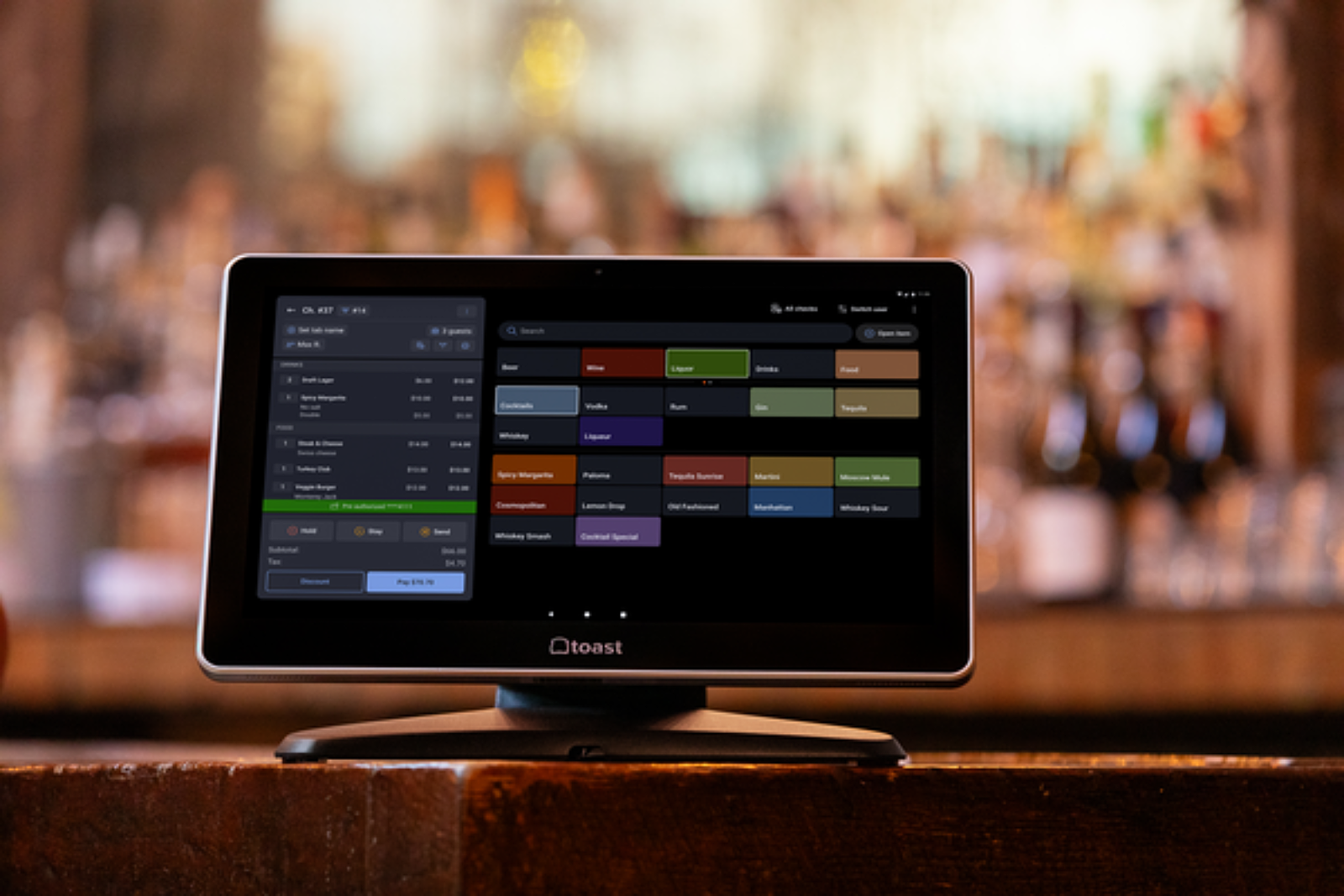
Toast point of sale software UX UI
The trajectory is intelligible: Toast is investing in reducing handoff friction between front-of-house touchpoints and enriching contextual information at the ordering screen. The core navigation structure has not been overhauled. This is a constraint respecting approach with real operational value, particularly in high-turnover environments where retraining costs compound with every cycle.
The practitioner frustration accounts tell a more complicated story. A verified Capterra review documents a printer routing error in Toast that persisted for two years across multiple support escalations, with delivery receipts printing to the wrong device throughout. The same review describes void and refund workflows that fail mid-transaction, generating chargebacks that Toast subsequently charged fees for. A separate reviewer describes the labour scheduling interface as so confusing that the operation abandoned it entirely and returned to a manual system.
The labour scheduling account is diagnostically precise. It describes sense decay in its textbook form: a feature that exists within the product, presumably functional when shipped, that has drifted so far from how managers actually schedule staff that the manual alternative now has lower friction. The system is not broken; it is unusable. The distinction matters for a product director deciding where to invest, because an unusable feature carries a different remediation cost than a broken one.
Operational Coherence Test: Toast scores best on conditioning stability, having preserved its core navigation structure through a continuous additive release cycle. Error recovery is where the model breaks down: the printer error account and the void-and-refund failure describe workflows where the recovery path is not only slow but actively generates downstream cost.
Lightspeed POS
Lightspeed has absorbed its former Vend acquisition fully into the Lightspeed Retail brand and added AI-backed demand planning and expanded international tax compliance. In August 2025, Expert Market published hands-on assessments of both Lightspeed Restaurant and Lightspeed Retail and found that both were not the easiest systems to use, citing unclear signposting and system glitches. Creating discounts was identified as problematic. Table plan changes could not be made from the front end, requiring a navigation step that competitors handle in-place.
No front-end redesign of Lightspeed's cashier-facing interface is publicly documented for the 2023 to 2026 period. The platform has not regressed; it has not advanced. In a market where Square and Toast are releasing substantive updates on a cycle of months, stability without investment is not the same as operational coherence. The two are different claims with different consequences. Interfaces that do not improve under competitive pressure accumulate usability debt in the same way that products do.
Operational Coherence Test: The signposting failures identified in independent testing suggest taxonomy alignment is unresolved. Attention economy suffers when navigation requires deliberate reading: cashiers cannot operate on muscle memory when the path to an action is not predictable.
NCR Aloha / NCR Voyix
NCR Corporation split into two public entities in October 2023. The Aloha brand moved to NCR Voyix, which subsequently sold its digital banking division and appointed a new CEO in February 2025. The corporate restructuring has not produced a meaningful change in the cashier-facing interface.

NCR POS user interface
Independent review as of February 2026 describes the platform as carrying a steeper learning curve than modern alternatives, with complexity extending setup times. Verified Capterra reviews from 2023 to 2025 use consistent language: "huge learning curve," "slow to move monolith," limited UI customisation. One ten-year client's account documents a request to customise button colours on the digital POS screen, with that request only partially implemented after years of use. A different long-term client review explicitly recommended against the platform for any business or commerce application.
The button colour account is worth stopping on. It is not a complaint about a missing feature. It is a complaint about interface ownership. A cashier-facing interface that cannot be configured to the operational reality of a specific retail environment is an interface that demands adaptation from the user rather than from the product. In a high-turnover environment, that demand is paid in training time on every hire cycle, against a base rate of 75.8% annual turnover for hourly retail roles (as of 2024).
Operational Coherence Test: NCR Aloha fails on attention economy and conditioning stability by design. Clients who have built operational workflows around it cannot migrate without significant retraining cost, but they are also absorbing continuous interface friction that does not resolve because the interface is not changing to meet them.
Oracle MICROS Simphony
Oracle introduced a new pricing tier in 2025: Essentials at $55 per month, with $1 hardware for businesses switching platforms. This has made the platform accessible to a segment that previously required enterprise-scale investment. The underlying interface has not been substantially redesigned. Independent review as of January 2026 describes the learning curve as still steep, with slow customer support. A Capterra review describes switching from MICROS to Simphony Cloud as a significant mistake. Another describes the button interface as feeling wrong, noting the platform is not the most user-friendly POS system the reviewer has used.
The pricing change is a commercial decision. It expands the addressable market for a product that has not resolved the operational coherence problems that its long-term users have documented. A cashier encountering Simphony for the first time in 2026 encounters the same learning curve that reviewers described in 2023.
Operational Coherence Test: Simphony carries the same structural limitations as NCR Aloha: a steep initial learning curve, conditioning requirements that depend on long familiarity rather than on interface legibility, and error recovery that routes through support rather than through self-resolving design.
Why Feature Investment Fails to Fix the Interface
The standard defence of the platforms reviewed here runs as follows: look at the release velocity. Square shipped three significant UX updates in eighteen months. Toast adds features on a numbered cycle measured in weeks. The market is investing. The interfaces are improving.
The argument fails on the evidence. Square's September 2025 forced rollout produced immediate performance failures in product search: the single most critical cashier-facing function when a scanner fails or a product does not scan correctly. Toast's most heavily cited user frustration is a workflow failure that persisted for two years inside a platform with a documented improvement history. Lightspeed added demand planning and tax compliance while its cashier-facing navigation remained flagged by independent reviewers as unclear.
Feature accumulation and operational coherence are not the same investment.
The work we did with SOCAR across a three-year POS programme, involving field research at seven stations under conditions ranging from -20 degrees to +40 degrees Celsius, showed that every design decision which survives contact with operational reality has to be traceable to observed behaviour rather than to stakeholder requests or usage analytics read from a distance. Features that emerge without that grounding produce sense decay: the accumulated gap between what the interface was designed to express and what it now communicates to the person using it at transaction 67 of 200 in a shift.
The competitive vector is not faster feature release. A platform that resolves the taxonomy alignment problem structurally, so that a cashier finds a product using the name they know rather than the name the database was built around, will win the account from a platform with superior reporting. Taxonomy failure creates queue-forming delays. Reporting depth does not compensate for queue-forming delays.
Sense decay in POS software occurs when a cashier-facing interface accumulates updates until the original operational logic is no longer readable in the product. It is visible when a printer error persists for two years through a documented release cycle, when labour scheduling software is abandoned for manual alternatives despite being included in the platform subscription, and when a forced UI update produces immediate search latency failures at the function cashiers depend on when a scanner fails.
What Structural Investment Produces
Across assessments of cashier-facing interfaces against real operational conditions, the consistent finding is that the gap between what IT managers expect cashiers to do and what cashiers actually do under pressure is wider than either party has usually measured. The methods that close this gap are field observation and contextual inquiry in the live environment, not usability testing conducted against a specification. The specific conditions of POS use, distance from screen, time pressure from queues, attention divided between customer and interface, are not accurately modelled in a lab session.
Four principles follow from the benchmarking evidence.
1. Treat the forced update as a design event. Every mandatory UI change resets cashier conditioning. A platform that ships forced updates without transition support transfers retraining cost to the operator. This cost does not appear in the product changelog. It appears in time-per-transaction data and in the turnover figures of cashiers who find the updated interface more stressful than the role already is.
2. Design error recovery before designing the transaction flow. The verified accounts from Toast and NCR Aloha show that the most expensive UX failures are not in the primary transaction path. They are in what happens when something goes wrong at transaction 67 of 200 in a shift. Error recovery paths that require navigation, re-entry, or phone support are not edge case failures. They are predictable operational cost.
3. Resolve taxonomy alignment structurally. The mismatch between how a product database is structured and how a cashier names products when a scan fails was documented in practitioner research in 2019. Square's product search complaints in 2025 confirm it remains active. Training cashiers to use the system's taxonomy is a short-term fix and a compounding liability as turnover rates stay above 75%.
4. Resist the customisation reflex. Customisation appears to solve the constraint respecting problem: let each operator configure the interface to their operational reality. In practice, customisation that is not anchored to a principled underlying model produces inconsistency across shifts and locations, creates accountability gaps when a configuration was set by an employee who has since left, and transfers the coherence burden from the product team to the operator. An interface that only achieves coherence after significant per-installation configuration is not a coherent interface; it is a coherence kit.
Limits and Gaps
This benchmarking review relies on public documentation, independent reviewer assessments, and verified practitioner accounts. It does not reflect direct access to vendor development roadmaps, internal usability testing data, or systematic observation of cashier behaviour across a representative sample of retail environments.
The practitioner frustration accounts are drawn from review platforms where negative experiences are overrepresented relative to neutral ones. They document real failure modes but cannot establish failure rates. A product director should use them as directional evidence about where operational coherence breaks down, not as prevalence data.
The business impact figures carry varying confidence levels. The $620,000 annual turnover cost estimate is consistent with Centre for American Progress methodology applied to retail sector averages. Transaction time improvement claims attributed to modern POS systems trace to secondary compilations without named primary studies, and are treated here as directional indicators only.
New entrants including SpotOn, GoTab, and Restroworks now appear in review roundups that previously featured only Square, Toast, and Lightspeed. This review has not assessed them. Their cashier-facing interface design decisions are not yet documented in the volume of independent practitioner accounts that makes pattern-level analysis reliable. They may outperform the incumbents reviewed here on operational coherence. The evidence is not yet available.
Conclusion
The cashier who cannot find a product through a two-second delayed search is forming a queue. The cashier whose cash drawer now opens at the end of the transaction instead of the beginning has to consciously override a physical sequence their hands have performed thousands of times. Neither failure appears in a feature comparison table. Both appear in the operational cost of running a retail environment.
The platforms reviewed here are not failing for want of investment. They are failing because the investment is concentrated in feature surface rather than operational coherence. Square ships visual redesigns that break cashier conditioning on forced deployment. Toast adds contextual intelligence to terminals without resolving the error recovery failures documented in its own verified user base. NCR Aloha holds institutional ground while its long-term clients describe learning curves that never fully resolve and customisation requests that take years to partially implement.
The global POS software market was worth approximately $29 billion in 2023. The two largest platforms hold roughly half of it. The interface quality that practitioners describe in verified accounts from 2025 suggests that operational coherence remains an open competitive position, not a solved problem.
A product team that begins its next redesign cycle with field research in live retail environments, and that assesses every update decision against the Operational Coherence Test criteria, is working on a different problem than the one most of the market is currently funding.
Frequently Asked Questions
What is the Operational Coherence Test? The Operational Coherence Test is a four-criterion framework for assessing whether a POS interface holds up under real cashier conditions. The criteria are: attention economy (can the interface be used without sustained visual focus?), conditioning stability (does it survive updates without disrupting established motor sequences?), taxonomy alignment (does item search match how cashiers name products?), and error recovery speed (how much time and how many steps does a failed transaction add?). It is designed to be applied through field observation in live retail environments.
Which major POS platform scores best on operational coherence in 2026? No platform assessed here performs consistently across all four Operational Coherence Test criteria. Toast scores highest on conditioning stability, having preserved its core navigation structure through a continuous additive release cycle. Square has invested most in taxonomy alignment through AI-powered search, but the September 2025 search latency complaints from Square Community forum users indicate the implementation is not yet reliable under load conditions. NCR Aloha and Oracle MICROS Simphony both carry structural learning curve problems that independent reviewers from 2023 to 2026 consistently describe as unresolved.
Why does POS interface quality affect staff turnover? Cashier turnover in hourly retail roles runs at approximately 75.8% annually (as of 2024). A POS interface that generates sustained friction, through unclear navigation, slow error recovery, or conditioning disruption from forced updates, is a named contributor to cashier dissatisfaction. Turnover costs for a 100-employee retailer are estimated at $620,000 per year (Appriss Retail, November 2025). An interface that is measurably harder to use than its competitors compounds against the base turnover rate rather than reducing it.
What is sense decay, and how does it appear in POS software? Sense decay occurs when a product accumulates features and release cycles until the original operational logic is no longer readable in the interface. In POS software, the cashier-facing screen may have been designed around a coherent transaction model that has since been overlaid with loyalty modules, AI upsell prompts, management reporting hooks, and payment flow redesigns. When the accumulated result no longer maps to how a cashier processes a transaction under time pressure, sense decay has set in. The labour scheduling abandonment account from Toast is a textbook example.
How does customisation affect POS interface coherence? Customisation appears to solve the constraint respecting problem by allowing operators to configure the interface to their operational reality. In practice, customisation that is not anchored to a principled underlying model produces inconsistency across shifts, creates accountability gaps when a configuration was made by an employee who has since left, and transfers the coherence burden from the product team to the operator. The NCR Aloha button colour request documents a more acute version of this: even minor customisations were unavailable or only partially implemented, leaving the operator with no recourse.
Should the new entrant POS platforms be assessed differently from incumbents? SpotOn, GoTab, and Restroworks have received practitioner accounts that contrast them favourably with NCR Aloha and Oracle MICROS Simphony on learnability. The volume of verified long-term practitioner accounts available for conditioning stability and error recovery analysis is not yet comparable to the incumbent evidence base. Positive first-impression accounts are not the same as evidence of operational coherence under sustained high-throughput use. They may be better. The evidence does not yet confirm it at the same confidence level.
References
Appriss Retail. (2025, November 6). Retail loss prevention: Cashier misconduct and POS-related shrinkage categories. https://apprissretail.com/blog/retail-loss-prevention-strategies/
Bureau of Labor Statistics. (2024, May). Retail sector hourly employee turnover analysis [Analysis by DailyPay, based on BLS JOLTS data]. https://www.dailypay.com/resource-center/blog/retail-employee-turnover/
Center for American Progress. (2012). There are significant business costs to replacing employees. Cited in: Sparkplug.app. (2024). Employee retention guide for retail. https://sparkplug.app/
Expert Market. (2025, August 22). Lightspeed POS review: Restaurant and Retail hands-on assessment. https://www.expertmarket.com/pos-systems/lightspeed-pos-review
Grand View Research. (2024). Global point of sale software market: size, share, and trends. Cited in: Host Merchant Services. (2026, January). POS market share analysis. https://www.hostmerchantservices.com/articles/pos-market-share/
POS USA. (2026, February). NCR Voyix Aloha POS review. https://www.pos.com/pos-reviews/aloha-cloud
POS USA. (2026, January). Oracle MICROS Simphony POS review. https://www.pos.com/pos-reviews/oracle-micros-simphony
Square. (2025, September). Square Register point of sale update: new UI community thread. Square Community Forum. https://squareup.com/us/en/community
Toast. (2025). Spring 2025 innovation hub: ToastIQ, digital chits, and payment flow redesign. https://pos.toasttab.com/innovation-hub
Usability Geek. (2019). User experience barriers in POS systems. https://usabilitygeek.com/user-experience-barriers-pos-systems/
In this story
Benchmarking review of Square, Toast, Lightspeed, NCR Aloha, and Oracle MICROS Simphony against the Operational Coherence Test: four criteria drawn from field research with cashiers in live retail environments. For product directors who need to understand what the current UX landscape is costing their organisation and where structural investment in interface coherence creates a competitive vector.